“Turnkey” is one of the most frequently used expressions in the construction sector.
It appears in property listings, company websites, brochures, and commercial proposals.
But what does it really mean?
For many, it simply indicates a completed home, ready to move into.
For others, it suggests convenience, simplicity, and a worry-free process.
In reality, the concept of turnkey construction is far more structured than it seems.
And not all “turnkey” solutions are the same.
Understanding what this model truly includes — and what it does not — is essential for anyone planning to build or renovate.
What “Turnkey” Should Mean
Literally, a turnkey project should mean:
A single point of responsibility managing the entire process, from design to final delivery of a fully completed property.
However, in practice, the term is often used loosely.
It may simply indicate:
- execution of construction works,
- coordination of subcontractors,
- delivery of a finished building.
Or it may include:
- architectural design,
- structural and systems engineering,
- site supervision,
- management of permits and approvals,
- continuous budget control,
- full construction coordination.
The difference between these interpretations is not minor.
It is structural.
Why the Term Is Often Misleading
In the construction market, “turnkey” has become a reassuring phrase — but not always a precise one.
It may refer to:
- a contractor executing a design created by others,
- a general contractor coordinating subcontractors,
- an integrated structure combining design and construction under one system.
For clients, these distinctions are not always immediately visible.
Yet they directly impact:
- final quality,
- cost control,
- management of variations,
- timeline reliability,
- overall project risk.
The key question is not whether the project is delivered complete.
The key question is how the process is structured to reach that delivery.
A True Turnkey Model: Not a Promise, but a Method
A genuinely integrated turnkey model does not begin with construction.
It begins with the integration of design, economic planning, and execution.
When these phases belong to the same organizational system, the project becomes:
- more coherent,
- more predictable,
- less exposed to unforeseen events,
- more controllable from a financial standpoint.
A real turnkey solution is based on a defined method.
Let’s examine what it should include.
1. Preliminary Analysis and Feasibility Study
Before construction even begins, a structured approach includes:
- regulatory and zoning verification,
- structural assessment,
- definition of functional and energy objectives,
- realistic budget estimation.
This phase is often underestimated, yet it is the most effective way to reduce future cost overruns and delays.
2. Integrated Design

In a true turnkey process, design is not separate from execution.
Architecture, structure, and systems are coordinated from the very beginning.
This allows:
- prevention of technical conflicts,
- optimization of construction solutions,
- reduction of costly on-site changes,
- alignment between design and budget from day one.
The integration between design and construction is the core of the model.
3. Continuous Budget Planning
Many clients choose turnkey construction to gain cost certainty.
But certainty does not come from a fixed number alone — it comes from ongoing control.
A structured method includes:
- economic verification at every decision stage,
- cost evaluation linked to technical choices,
- proactive management of potential variations.
Financial transparency is not optional — it is integral to the process.
4. Execution Coordination and Single Responsibility
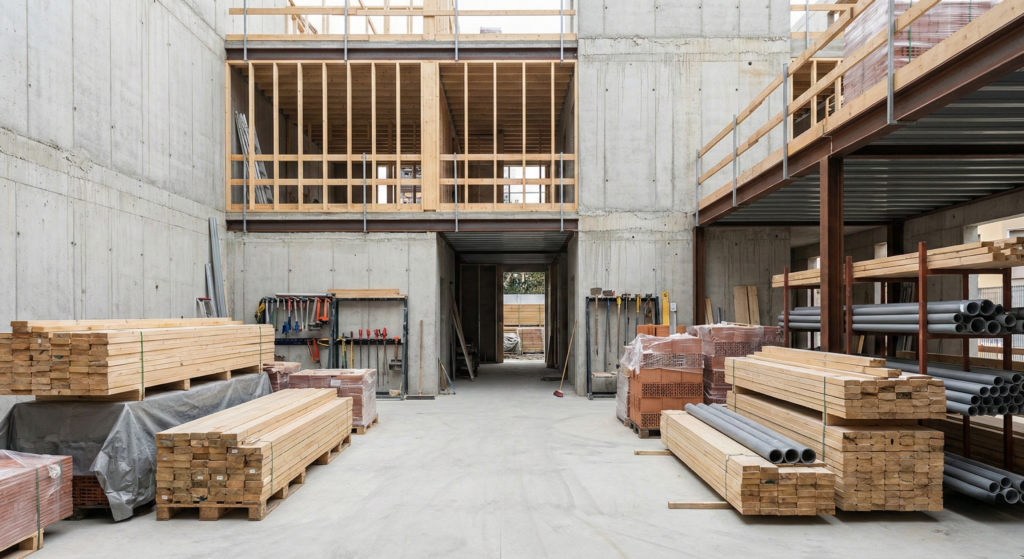
The construction phase is often the most complex stage of any project.
A true turnkey model provides:
- continuous site supervision,
- coordination of all trades,
- quality control,
- adherence to the construction schedule.
Most importantly, it ensures a clear line of responsibility.
When design and construction are fragmented, accountability is often diluted.
When the process is integrated, responsibility remains unified.
And it is this unified responsibility that protects the client.
5. Complete and Verified Delivery
Final delivery is not simply about finishing construction.
It includes:
- system testing,
- certifications,
- complete technical documentation,
- quality verification,
- compliance confirmation.
Only at this stage does the term “turnkey” fully reflect its meaning.
What a True Turnkey Model Is Not
For clarity, it is equally important to define what does not qualify as a genuine turnkey process.
It is not turnkey when:
- the design is prepared by an external party without coordination with the contractor,
- the budget is not systematically monitored,
- changes arise due to insufficient planning,
- responsibility is fragmented across multiple actors without centralized oversight.
In such cases, the likelihood of delays and additional costs increases significantly.
Turnkey and Customization: A Common Misconception

There is a widespread belief that turnkey solutions limit personalization.
This is not necessarily true.
A well-structured integrated model can actually enhance customization by allowing:
- informed material selection,
- tailored technical solutions,
- optimized spatial layouts,
- coherence between aesthetics and performance.
The difference lies in whether customization happens within a coordinated system or through fragmented, unstructured decisions.
Why an Integrated Method Reduces Risk
Building or renovating involves managing:
- technical complexity,
- regulatory requirements,
- coordination of professionals,
- financial planning,
- operational timelines.
An integrated model reduces risk because it:
- anticipates problems rather than reacting to them,
- centralizes decision-making,
- maintains alignment between design and construction,
- eliminates responsibility gaps.
It does not eliminate complexity — it governs it.
The Difference Between a Slogan and a Structure
The real distinction is not between those who use the word “turnkey” and those who do not.
It is between those who use it as a slogan and those who apply it as a structured system.
A genuine turnkey approach is recognizable through:
- a defined process,
- a transparent methodology,
- unified responsibility,
- continuous monitoring,
- economic clarity.
Without these elements, the term loses substance.
Conclusion: Before the Service, the System

“Turnkey” is not a magic formula.
It is a project management model.
When design and construction belong to the same structured system, the process becomes more linear, more controllable, and less exposed to unforeseen issues.
A true turnkey solution is not measured by the promise of simplicity, but by the willingness to assume responsibility for the entire process.
It is this responsibility that reduces risk.
It is this method that transforms construction into a governed project.
Before choosing a turnkey solution, it is worth asking not only what is included, but how the process is structured.
Because the difference between a complex experience and a truly guided journey begins right there.