For years, tax incentives and extraordinary bonuses heavily influenced decisions in the construction sector. In many cases, the question was not whether to renovate, but how quickly it could be done before deadlines expired.
Today, the context has changed.
With the end of major incentive schemes, the decision between renovating an existing property and building a new one has returned to what it should always have been: a rational, strategic evaluation.
Yet many clients still underestimate crucial factors such as regulatory constraints, indirect costs and realistic timelines. Choosing correctly requires clarity, not assumptions.
This is not about personal preferences.
It is about understanding which option truly makes sense in a specific context.
The First Question: What Is the Real Objective?
Before comparing renovation and new construction, one fundamental question must be asked:
What is the real goal of the project?
- Increasing property value?
- Improving comfort and energy performance?
- Optimizing layout and functionality?
- Creating a long-term family residence?
- Developing an investment property?
Without a clear objective, the comparison becomes distorted.
Renovating may seem more convenient at first glance, while building new may appear more expensive. But the true comparison must be based on results achieved, not just initial budget figures.
Renovating: Advantages and Hidden Complexities
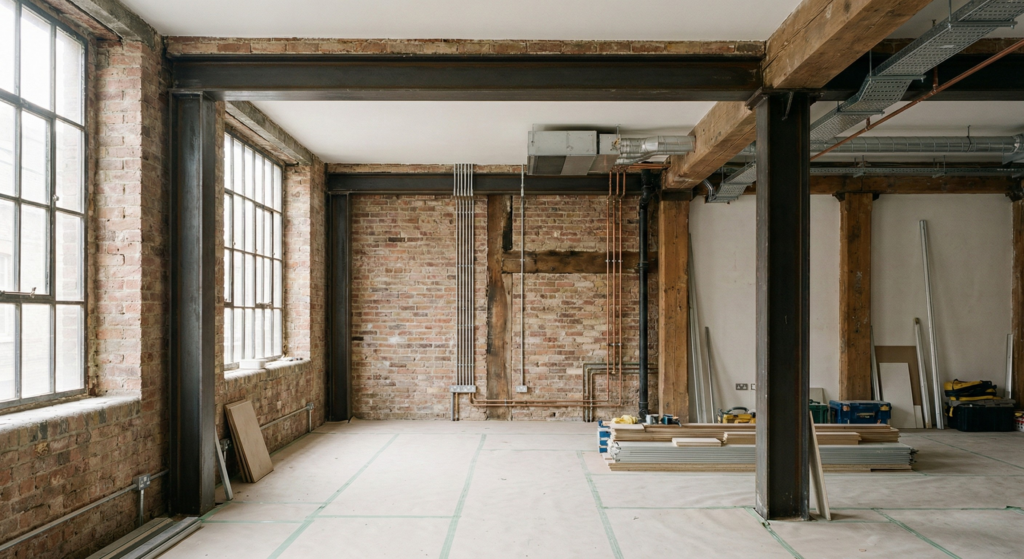
Renovation often feels like the most immediate and conservative choice. The structure already exists. The location is established. The building may have historical or emotional value.
Potential Advantages
- Lower initial perception of cost
- Preservation of existing character
- Shorter administrative path in some cases
- Possibility to improve value without demolishing
However, renovation projects frequently conceal complexities that are not immediately visible.
Structural and Technical Constraints
Existing buildings come with limitations:
- load-bearing walls that cannot be removed,
- outdated structural systems,
- non-compliant installations,
- limited ceiling heights,
- irregular layouts.
Adapting a modern lifestyle to an old structure can require significant compromise.
Energy and Performance Limits
Improving energy efficiency in an existing building is possible, but rarely without constraints. Achieving the highest performance levels may require invasive interventions:
- façade insulation,
- roof reconstruction,
- full system replacement.
In some cases, structural or urban constraints limit what can realistically be achieved.
Hidden Costs
One of the most underestimated risks in renovation is the presence of unforeseen conditions:
- hidden structural issues,
- moisture damage,
- outdated plumbing or wiring,
- non-compliant previous alterations.
These elements can significantly increase costs during construction.
Renovation is rarely linear.
It often involves adaptation and adjustment along the way.
Building New: Greater Freedom, Greater Control

New construction, on the other hand, begins with a blank page.
This does not automatically make it the right choice—but it changes the variables involved.
Design Freedom
A new building allows:
- optimized orientation,
- ideal layout planning,
- integration of systems from the beginning,
- coherent architectural vision.
Every decision can be made strategically, without being constrained by existing structures.
Predictability of Costs
While the initial investment may appear higher, new construction often offers:
- clearer cost forecasting,
- fewer unexpected structural issues,
- better alignment between design and execution.
When properly planned, cost control tends to be more stable.
Higher Energy Performance
Achieving high energy classes is significantly easier in new construction because:
- insulation and envelope performance are integrated from the start,
- systems are designed coherently,
- regulatory standards are already aligned with modern performance levels.
This has long-term implications in terms of property value and operational costs.
Regulatory Framework: A Decisive Factor
One of the most critical elements in choosing between renovation and new construction is regulatory feasibility.
Renovation Constraints
Renovation projects must comply with:
- local urban planning rules,
- structural safety regulations,
- heritage or landscape restrictions (if applicable),
- limitations imposed by condominium settings.
In some cases, obtaining permits for significant modifications may be complex or limited.
New Construction Constraints
New builds must comply with:
- zoning regulations,
- volumetric indices,
- setback requirements,
- environmental and landscape restrictions.
However, once feasibility is confirmed, the regulatory framework is often clearer and more predictable.
In both cases, preliminary technical analysis is essential.
Assumptions can lead to costly delays.
Timing: Perception vs Realit
Many people assume renovation is always faster.
This is not necessarily true.
Renovation timelines can be affected by:
- discovery of hidden structural issues,
- design modifications during construction,
- coordination difficulties in partially occupied buildings,
- permit adjustments.
New construction requires:
- feasibility studies,
- design development,
- permitting,
- full construction cycle.
But once started, the process is often more structured and linear.
The real question is not “Which is faster?”
It is “Which process is more predictable for this specific case?”
Long-Term Perspective: Value and Obsolescence
A crucial aspect often overlooked is long-term resilience.
A renovated building may improve substantially—but some inherent limitations may remain:
- structural grid constraints,
- ceiling heights,
- limited natural light,
- less adaptable layouts.
A newly built property can be designed to meet:
- contemporary comfort standards,
- future energy regulations,
- evolving lifestyle needs.
When evaluating an investment over 20 or 30 years, these differences matter significantly.
Cost Comparison: Looking Beyond the Surface

Comparing renovation and new construction purely by initial budget is misleading.
A proper comparison should include:
- Design and consultancy fees
- Construction costs
- Structural adaptation costs
- Energy upgrade interventions
- Permit and compliance procedures
- Long-term maintenance expectations
- Operational energy costs
Sometimes renovation is more convenient.
Sometimes new construction offers better long-term efficiency.
The correct choice depends on the relationship between short-term investment and long-term performance.
Emotional Value vs Functional Value
There are situations where renovation makes sense beyond numbers:
- historical buildings,
- family properties,
- architecturally unique structures,
- urban contexts where demolition is not viable.
In these cases, the emotional or contextual value may outweigh pure efficiency.
However, when the goal is optimization, performance and long-term predictability, new construction may offer stronger advantages.
The key is clarity—not attachment to a predefined solution.
The Role of Professional Guidance

The most common mistake clients make is deciding before conducting a full technical feasibility analysis.
Without:
- structural assessment,
- regulatory verification,
- cost estimation scenarios,
- performance evaluation,
the choice remains speculative.
A structured comparative analysis allows:
- realistic budgeting,
- timeline estimation,
- risk assessment,
- value projection.
This is where a consultancy-driven approach becomes essential—before any construction decision is made.
Conclusion: The Right Choice Is Contextual, Not Ideological
Renovating and building new are not opposing philosophies.
They are tools.
The right decision depends on:
- the existing condition of the property,
- regulatory feasibility,
- investment horizon,
- performance expectations,
- risk tolerance.
In a market no longer driven by extraordinary incentives, the choice must return to fundamentals:
coherence between objectives, constraints and long-term value.
There is no universal answer.
There is only the answer that fits a specific context—after careful evaluation.